
Continuous HEPA air scrubbing and filtration to reduce airborne mold spore counts inside containment zones at commercial properties in Modesto.
HEPA air scrubbing and filtration is an air quality control measure used inside mold remediation containment zones to continuously capture airborne mold spores and fine particulates during remediation work. Air scrubbers draw room air through a series of filters, with a true HEPA filter capturing particles down to 0.3 microns. Equipment runs throughout the project to reduce the airborne spore count inside the work zone. RedTag Property Mitigation deploys HEPA air scrubbers as part of mold mitigation work throughout Modesto, CA and the Central Valley. Call(209) 424-8233 for 24/7 emergency response in Modesto.
Let’s get your project quote started.

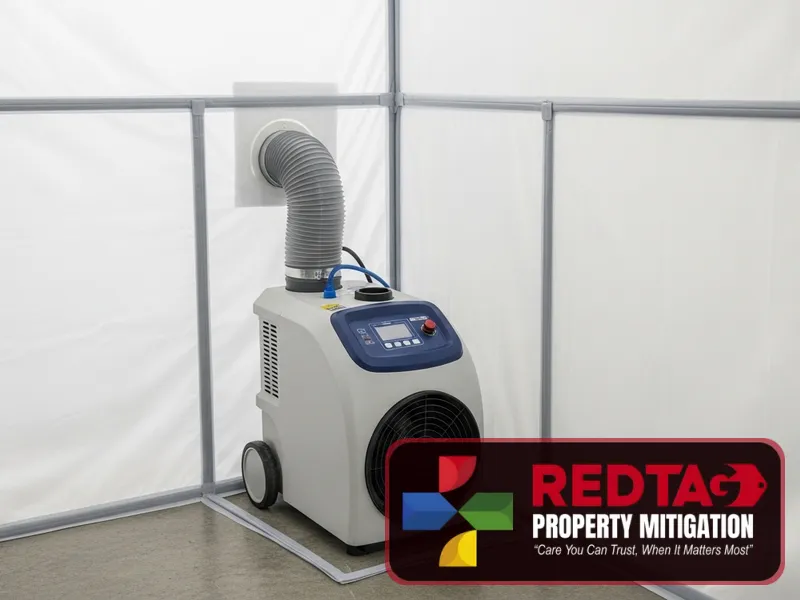
A HEPA air scrubber is a self-contained filtration unit that draws air in through one side, passes it through a multi-stage filter stack, and exhausts cleaned air from the other side back into the room. The final filter stage is a true HEPA filter rated to capture 99.97 percent of particles at 0.3 microns, which covers the full size range of mold spores. Units are positioned inside the containment zone and run continuously during all remediation work and overnight when the project remains active.
HEPA air scrubbers use a multi-stage filter system to manage different particle sizes. A pre-filter captures large dust and debris particles before they reach the main filter stages. A carbon or activated charcoal filter may be included to address odor compounds. The final HEPA stage captures fine particulates including mold spores, mycotoxin-carrying particles, and other airborne contaminants within the containment zone. Pre-filters are replaced as they load to protect the HEPA stage and maintain consistent airflow through the unit.
Air scrubber positioning inside the containment zone affects how efficiently the equipment captures airborne spores during work. Units are placed to create a clean-to-dirty air flow path across the work area, drawing air from the cleaner entry side toward the dirtier demolition side before it is filtered and recirculated. Positioning is coordinated withnegative air pressure system placement to avoid short-circuit airflow patterns that would reduce the effectiveness of both systems operating inside the zone.
The number of air changes per hour achieved by the air scrubber determines how quickly airborne spore concentrations are reduced inside the containment zone. Machine capacity is matched to the cubic footage of the contained space to achieve the minimum air change rates specified by IICRC S520 for mold remediation. In heavily contaminated areas or where multiple workers are disturbing material simultaneously, additional units may be deployed to maintain appropriate air change rates throughout the work period.

HEPA air scrubbers run continuously during all working hours while remediation activity is occurring inside the containment zone. Units are not shut down during breaks or between demolition phases, as the goal is to maintain consistent reduction of airborne spore concentrations at all times. Overnight operation is maintained when material removal work is not yet complete and the containment zone remains active. Equipment is checked at the start of each workday for filter condition and operational status.
Pre-filters and carbon filters in the air scrubber stack are inspected and replaced based on loading, usage time, and the spore and particulate volume in the work zone. A clogged pre-filter reduces airflow through the unit and lowers the number of air changes per hour achieved inside the containment zone. HEPA filter replacement follows manufacturer guidelines and is based on differential pressure readings rather than time intervals. Filter changes are documented as part of the project record.
HEPA air scrubbing operates alongside and aftermold affected material removal. Material removal is the most disruptive phase of remediation and generates the highest airborne spore concentrations inside the containment zone. Air scrubbers running during and after demolition capture released spores before they can settle on cleaned surfaces. Scrubbing also continues during surface cleaning phases to manage residual airborne particles aftermold containment barriers and engineering controls have isolated the work area.
HEPA air scrubber deployment is documented throughout the mold remediation project. Documentation includes equipment placement photographs, unit model and filter specifications, daily operational status logs, filter inspection and replacement records, and air change rate calculations for the containment zone. This record forms part of the overall project documentation package submitted to the insurance carrier and made available to the clearance inspector. Complete air scrubbing documentation supports the verification that air quality was managed per IICRC S520 standards throughout remediation.
Contact RedTag Property Mitigation for information about HEPA air scrubbing and filtration for mold remediation in Modesto. Equipment capacity and configuration details can be confirmed.
HEPA air scrubbing and filtration in Modesto covers several components, each serving a specific function in managing air quality inside mold remediation containment zones.
Air quality management inside the containment zone is a required component of the broadermold mitigation support process in Modesto. HEPA air scrubbing runs throughout the project from first entry to final clearance preparation.
HEPA air scrubber deployment follows IICRC S520 requirements for air quality management inside mold remediation containment zones. S520 specifies minimum air change rates, filtration requirements, and equipment monitoring protocols. Meeting these standards ensures the air quality record satisfies insurance carrier and clearance inspector expectations.
Commercial properties with large containment zones require higher-capacity air scrubbers or multiple units to achieve the required air change rates per IICRC S520. Equipment is sized to the cubic footage of each containment zone across office buildings, retail centers, multifamily units, and industrial facilities throughout Modesto.
Air scrubber positioning is planned alongsidenegative air pressure system placement to ensure both systems work together rather than creating competing airflow patterns inside the containment zone. Coordinated setup prevents short-circuit airflow that reduces the effectiveness of either system during the project.
Air scrubber operational status, filter condition, and placement are checked and recorded at the start of each workday. Filter replacements are documented with dates and unit references. These records are compiled into the project documentation package for the insurance carrier and post-remediation clearance inspector throughout the remediation.
Mold situations identified in occupied commercial buildings often require rapid containment and air quality control to limit ongoing exposure. HEPA air scrubber deployment is available around the clock for commercial and residential properties throughout Modesto and the Central Valley. Call(209) 424-8233 for emergency dispatch.

Contact RedTag Property Mitigation at(209) 424-8233 to discuss HEPA air scrubbing and filtration requirements for a specific mold remediation project at a commercial or residential property in Modesto.

Before air scrubbers are placed, the cubic footage of each containment zone is calculated and the required air change rate is determined per IICRC S520. Machine capacity is matched to the zone volume. Additional units are scheduled for zones where a single scrubber cannot achieve the minimum air change requirement.
Air scrubbers are positioned inside the containment zone to create a clean-to-dirty airflow path across the work area. Placement is coordinated with the negative air machine location and the entry airlock position to avoid short-circuit airflow patterns that would reduce filtration efficiency across the zone.
Air scrubbers are switched on and allowed to complete at least one full air change cycle beforemold affected material removal begins. Starting filtration before demolition work provides a baseline of reduced airborne particles inside the zone and ensures equipment is confirmed operational before the highest spore-generating activities start.
Scrubbers run without interruption during all material removal, surface cleaning, and antimicrobial treatment phases inside the containment zone. Equipment status is checked at the start of each workday. Pre-filters are inspected and replaced as needed to maintain consistent airflow and filtration performance throughout the project.
Once remediation work is complete and the site is ready forpost-remediation clearance preparation, air scrubbing records are compiled into the project documentation file. Equipment logs, filter records, and placement photographs are included in the package submitted to the insurance carrier and clearance inspector.
HEPA air scrubbing and filtration in Modesto follows a defined sequence from initial equipment sizing through continuous operation and daily monitoring across the remediation project.
Contact RedTag Property Mitigation at(209) 424-8233 for information about HEPA air scrubbing setup for mold remediation projects throughout Modesto and the Central Valley.
HEPA air scrubbing and filtration reduces airborne mold spore concentrations inside the containment zone during remediation, protects the remediation crew and building occupants in adjacent spaces, and produces air quality records that support insurance review and clearance testing.
Mold spores disturbed during material removal become airborne inside the containment zone. Continuous HEPA filtration progressively reduces the concentration of those spores throughout the workday. Lower airborne spore counts reduce crew exposure and improve the air quality conditions present at the time of clearance testing.
Airborne spores that are not captured settle onto surfaces that have already been cleaned inside the containment zone. Continuous air scrubbing during and after surface cleaning reduces the quantity of spores available to resettle on cleaned framing, walls, and structural surfaces before clearance testing is performed.
The highest airborne spore concentrations inside a containment zone occur during material removal and demolition. Running air scrubbers throughout demolition work reduces the spore concentration remediation crews are exposed to inside the zone, even when full personal protective equipment is in use during the project.
Daily air scrubbing logs, filter records, unit placement photographs, and air change calculations are compiled throughout the project. This record provides evidence to the insurance carrier that appropriate air quality controls were maintained throughout remediation, reducing the risk of disputes over whether proper procedures were followed.
Post-remediation clearance testing by a certified industrial hygienist assesses whether airborne mold spore concentrations inside the treated area are within acceptable limits. Continuous HEPA filtration throughout the project reduces the residual airborne spore count, supporting the air quality conditions needed to produce a passing clearance test result.

These outcomes make HEPA air scrubbing and filtration a required air quality control measure for mold remediation in Modesto. Contact RedTag Property Mitigation to discuss equipment requirements for a specific commercial or residential mold situation.
RedTag Property Mitigation deploys HEPA air scrubbing and filtration equipment for mold remediation throughout Modesto from coordinates 37.6391 N, 120.9969 W in California. Service coverage extends across the Central Valley metropolitan area and surrounding suburbs.

HEPA air scrubbing deployment in Central Modesto covers commercial and residential properties across Downtown Modesto, Sylvan, Beyer Park, the College Area, Lakewood, Creekwood, Village One, and the Airport District throughout the central zone of the city.
Sub-areas covered: Downtown Modesto, Sylvan, Beyer Park, College Area, Lakewood, Creekwood, Village One, Airport District.
Coverage extends north into Salida, Riverdale Park, Ceres, Turlock, Denair, Keyes, and Hughson. This zone includes residential subdivisions, multifamily properties, and commercial buildings along the Highway 99 corridor through Stanislaus County north and south of the city.
Sub-areas covered: Salida, Riverdale Park, Ceres, Turlock, Denair, Keyes, Hughson.
Stockton and Tracy are covered as secondary service cities for HEPA air scrubbing in mold remediation projects. Coverage includes North Stockton, Lincoln Village, Sherwood Manor, Mountain House, Lathrop, and Manteca for commercial mold situations throughout the corridor between Modesto and Stockton.
Sub-areas covered: North Stockton, Lincoln Village, Sherwood Manor, Mountain House, Lathrop, Manteca.
Coverage extends along the Highway 99 corridor into Merced, Atwater, Livingston, Madera, Clovis, and Fresno. HEPA air scrubbing equipment for mold remediation projects in these communities is deployed throughout the Central Valley service area.
Sub-areas covered: Merced, Atwater, Livingston, Madera, Clovis, Fresno.
Select Bay Area locations including Hayward, Livermore, and Pleasanton are covered for commercial mold remediation projects requiring HEPA air scrubbing. Patterson, Newman, and Los Banos in the broader Central Valley are also served within the wider service region.
Sub-areas covered: Hayward, Livermore, Pleasanton, Patterson, Newman, Los Banos.
Contact RedTag Property Mitigation to confirm HEPA air scrubbing and filtration availability for mold remediation projects in specific Modesto locations. Coverage information is available for all suburbs listed throughout the Central Valley service area.
These questions cover the most common points raised about HEPA air scrubbing and filtration during mold remediation at commercial and residential properties in Modesto.
A HEPA air scrubber draws air from inside the containment zone through a multi-stage filter stack, capturing airborne mold spores and fine particulates. The filtered air is exhausted back into the room. This process runs continuously to reduce the airborne spore count inside the work zone.
A HEPA air scrubber recirculates filtered air back into the containment zone to reduce airborne spore counts. Anegative air pressure system exhausts air outward to create directional airflow. Both systems are typically used together during mold remediation to manage different aspects of air quality inside the zone.
Air scrubbers run continuously during all working hours while remediation activity is occurring inside the containment zone. Equipment also runs overnight when material removal is not yet complete. Operation stops only once clearance preparation is finished and the site is ready for third-party testing.

The number of units required depends on the cubic footage of each containment zone and the air change rate needed per IICRC S520. Larger commercial zones may require multiple units. Each containment zone is calculated separately, and equipment is deployed based on that calculation.
True HEPA filters capture 99.97 percent of airborne particles at 0.3 microns. Mold spores range from 1 to 30 microns, which falls well within the capture range of a true HEPA filter. Regular filter replacement maintains filtration performance at that level throughout the remediation project.
Air scrubbing continues through all material removal, surface cleaning, and antimicrobial treatment phases. Equipment runs until the site completespost-remediation clearance preparation and is ready for third-party clearance testing. Stopping air scrubbing before remediation is complete risks a rise in airborne spore counts inside the zone.
Contact RedTag Property Mitigation for additional questions about HEPA air scrubbing and filtration for mold remediation in Modesto and the Central Valley.
RedTag Property Mitigation deploys HEPA air scrubbing and filtration for mold remediation throughout Modesto and the Central Valley. Call(209) 424-8233 for 24/7 emergency response.
Contact RedTag Property Mitigation for information about HEPA air scrubbing in Modesto. Questions about equipment sizing, configuration, and project scope can be answered.