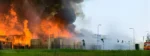
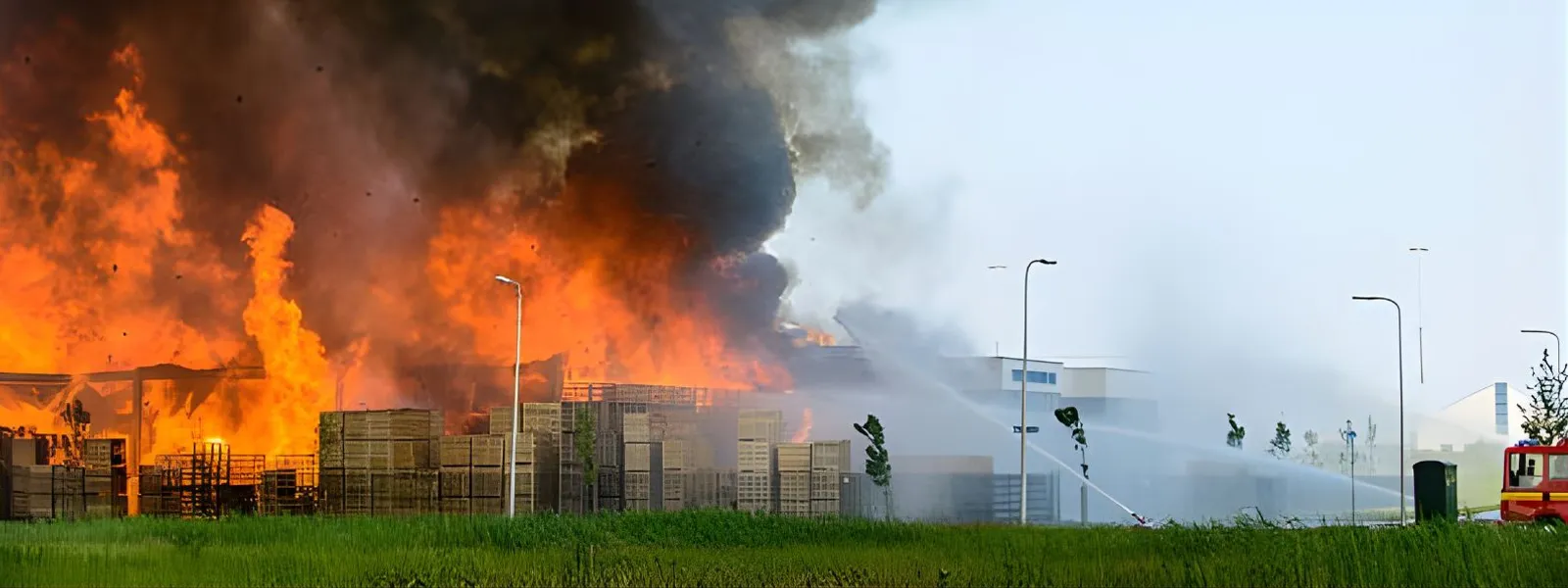
Just before 3 a.m. on Monday, April 6, 2026, the Stanislaus Consolidated Fire Protection District dispatched crews to the 600 block of Mariposa Road in Modesto. Arriving firefighters found a commercial building fully involved, with heavy flames throughout the structure. Six engines, two quints, two battalion chiefs, and the Stanislaus County Fire Investigation Unit responded. Given the intensity of the fire and the immediate threat to a nearby pallet yard, crews shifted to a defensive strategy, deploying multiple hose lines to contain the blaze and protect surrounding properties. No injuries were reported. The cause remains under investigation, according to the Modesto Bee report published April 6, 2026.
After several hours of suppression and overhaul operations, crews cleared the scene. What remained was a commercially compromised structure loaded with charred framing, burned debris, and suppression water-saturated materials. For the property owner, fire damaged material removal became the immediate next requirement. It is the step that determines whether a commercial building can move toward reconstruction, or whether it remains a compounding liability.
For commercial property owners, property managers, and insurance adjusters handling losses in Modesto and the Central Valley, understanding what fire damaged material removal involves, what it requires under California law, and why it cannot be delayed or shortcut is essential to protecting both the property and the claim.
What a Fully Involved Commercial Fire Leaves Behind
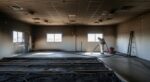
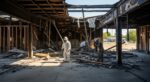
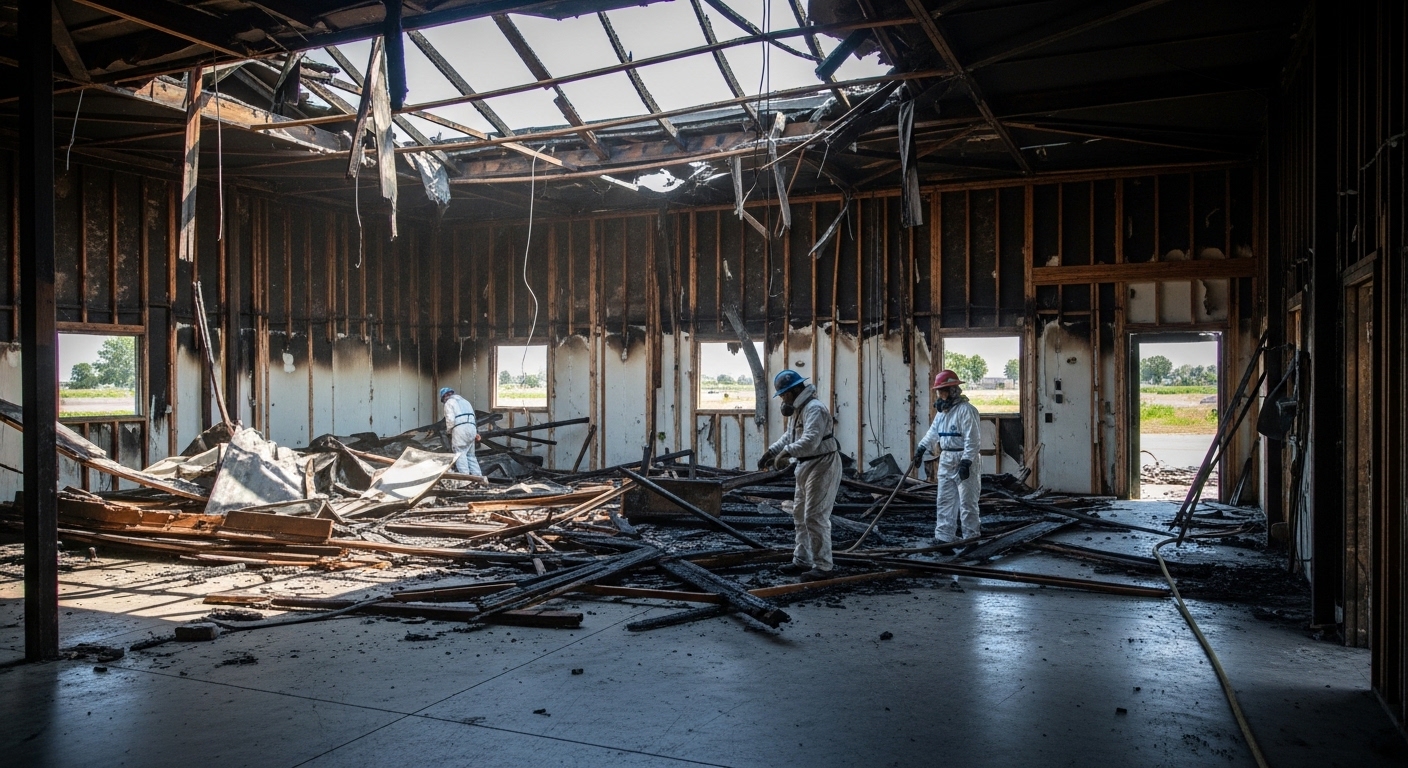
A commercial building that burns to full involvement does not simply need cleaning. The Mariposa Road fire is a direct example of what a defensive-strategy commercial fire loss looks like on the inside. Charred framing members that have lost structural integrity. Collapsed ceiling and wall assemblies. Burned insulation that has become fine particulate hazard material. Debris generated during overhaul operations, where firefighters open walls and ceilings to expose and extinguish hidden hot spots.
The Modesto Regional Fire Authority investigates more than 300 fires annually across Modesto and Stanislaus County. In a fully involved commercial loss, the volume of fire damaged material removal required following suppression is typically far greater than property owners anticipate. Overhaul alone creates significant additional debris as crews work to confirm the fire is completely extinguished throughout the structural assembly.
Beyond the visible debris, fire damaged buildings carry ongoing chemical hazards. Combustion byproducts, off-gassing from burned synthetic materials, and ash particulate continue releasing from charred materials for days after the fire is out. Workers, assessors, insurers, and future reconstruction crews entering the site are exposed to these hazards if the site is not professionally managed from the point of clearance forward.
What Fire Damaged Material Removal Involves
Fire damaged material removal is a structured, documented mitigation process with specific procedural requirements under California licensing and IICRC standards. It is not a cleanup task.
Charred debris removal covers all burned material that cannot be retained, including framing members, sheathing, roofing components, flooring substrate, and any building material that has been thermally compromised. A licensed professional evaluates what is safe to retain versus what must be removed. Attempting to preserve charred framing to reduce cost is among the most common and costly mistakes made after a commercial fire, because compromised framing that passes initial visual inspection can fail structural assessment later, delaying reconstruction and complicating the insurance scope.
Unsalvageable contents disposal is handled separately from structural debris. Commercial properties contain equipment, fixtures, racking, and stored inventory, all of which must be sorted, categorized, and disposed of according to their condition and applicable California environmental regulations. Materials with chemical contamination from the fire require specific handling and disposal protocols.
Fire damaged material removal also includes debris sorting, the systematic separation of materials that may retain insurance or salvage value from those designated for disposal. This step directly supports the documentation package that insurance adjusters require and is one of the areas where proper mitigation practice most directly affects the speed and outcome of the claim.
Pre-reconstruction site preparation, the final phase of fire damaged material removal, brings the site to a condition where a general contractor can safely enter, assess, and begin reconstruction planning. This includes antimicrobial surface preparation of exposed framing and subfloor, cleaning of structural substrate, and a formal contractor handoff documentation package that records the state of the site at completion.
Why Fire Damaged Material Cannot Be Left in Place
Delaying fire damaged material removal is one of the most damaging decisions a property owner can make after a commercial fire. The consequences are structural, biological, and financial.
From a structural standpoint, burned framing members continue to deteriorate after a fire. Exposure to suppression water accelerates the degradation of thermally compromised wood. What appears stable on day two can be significantly weaker by day ten. This matters during any subsequent structural assessment and matters even more when the building is subject to wind or seismic loads common across the Central Valley region.
From a biological standpoint, suppression water soaking into burned organic material creates ideal conditions for mold growth. In Modesto’s climate, mold can establish itself in as little as 48 hours under the temperature and humidity conditions that follow a fire loss. Secondary mold contamination compounds the original fire damage scope and adds a separate category of remediation cost to an already significant loss.
From a financial standpoint, fire damaged material left in place creates liability exposure, complicates the insurance scope, and delays reconstruction. Every day a fire-damaged commercial building sits without a cleared and documented site is a day the property owner is extending the recovery timeline and potentially allowing secondary damage to compound the original loss.
Licensing and Compliance Requirements in California
California has specific licensing requirements for contractors performing fire damaged material removal on commercial structures. The California Contractors State License Board requires contractors to hold a valid California license in an appropriate classification. For commercial fire debris removal, this means a General Contractor (B) license as a minimum. When hazardous materials are present, contractors must hold a Hazardous Substance Removal Certificate and ensure workers comply with HAZWOPER training requirements.
RedTag Property Mitigation operates as a division of Highly Favored Contractors Inc., holding CSLB General Contractor license #1130391. This licensing is a legal requirement for performing fire damaged material removal in California, and it directly affects whether an insurance claim will be accepted and whether the work will meet the standards required for reconstruction to proceed.
The CSLB explicitly warns that unlicensed contractors frequently approach property owners in the aftermath of a disaster with low-cost proposals. Engaging an unlicensed contractor for fire damaged material removal can invalidate insurance claims, create regulatory violations, and leave the property owner with personal liability for work that does not meet California code.
IICRC Standards and Insurance Documentation
Professional fire and smoke damage restoration is governed by IICRC standards for fire and smoke damage, which establish procedures, documentation requirements, and contractor qualifications for this category of work. For insurance purposes, IICRC-compliant documentation is often the difference between a claim that processes efficiently and one that stalls in adjuster review.
The standard requires that the scope of work, removal methods, and site conditions be documented in a format that aligns with what insurance carriers need to approve and process the claim. RedTag is IICRC certified to S500 and S520 standards and applies compliant documentation to every commercial fire loss, producing packages designed to work directly within the adjuster workflow.
The 2026 CAL FIRE incident data confirms that fire activity across California continues to generate commercial losses requiring structured mitigation response. The Mariposa Road fire is one of many commercial fire events this season that places fire damaged material removal at the center of a property owner’s immediate recovery obligations.
What Commercial Property Owners in Modesto Should Do First
If your commercial property or a property in your portfolio has been affected by fire in Modesto or anywhere across the Central Valley service area, the following sequence applies from the moment the fire authority clears the site.
Do not delay fire damaged material removal while waiting for insurance authorization. Most commercial property policies require the insured to take reasonable mitigation steps after a covered loss. Inaction during the critical post-fire window can be used by insurers to reduce payouts on secondary damage that developed while the site remained unsecured and uncleared.
Ensure the contractor you engage produces a complete documentation package: photo logs, debris categorization records, scope of work aligned with Xactimate format, and a pre-construction site readiness report. This documentation is the foundation of the insurance claim and the contractor handoff.
Verify California CSLB licensing before any contractor begins work. Fire damaged material removal on a commercial structure requires a licensed General Contractor. Confirm license status through the CSLB license check tool before signing any agreement.
RedTag Property Mitigation responds 24 hours a day, 7 days a week to commercial fire losses across Modesto and the Central Valley. Visit the contact page to request emergency dispatch.
Frequently Asked Questions
How is fire damaged material removal handled after a commercial building fire?
Fire damaged material removal after a commercial fire is a structured mitigation process performed by licensed contractors. It begins with a site assessment to determine which materials are structurally compromised and must be removed, followed by systematic removal of charred framing, insulation, wall assemblies, and flooring substrate. All debris is sorted into categories, with hazardous materials handled under California environmental regulations. The process is fully documented with photo logs, debris categorization records, and a scope of work report that supports the insurance claim. Work is performed in compliance with IICRC fire and smoke damage restoration standards.
What debris from a commercial fire is considered hazardous?
Debris from a commercial fire is hazardous when it contains combustion byproducts from synthetic materials, chemical compounds from burned equipment or inventory, asbestos-containing materials in older structures, and lead-containing materials in painted surfaces. Suppression water mixed with ash and burned material can also produce hazardous runoff. California requires HAZWOPER-trained workers for fire damaged material removal involving hazardous substances. A licensed mitigation contractor performing a full site assessment will identify hazardous materials before removal begins and document the handling and disposal process for regulatory compliance and insurance purposes.
How long does fire damaged material removal take for a commercial property?
The timeline for fire damaged material removal depends on the size of the structure, the extent of fire involvement, the volume of contents, and the presence of hazardous materials requiring specialized handling. For a fully involved commercial structure like the April 6 Mariposa Road fire in Modesto, initial debris clearance typically requires several days for a properly resourced mitigation crew. Full pre-reconstruction site preparation, including structural substrate cleaning, antimicrobial treatment, and documentation, takes additional time depending on scope. Each phase must be completed and documented before the site is handed to the reconstruction contractor.
Does fire damaged material removal require a licensed contractor in California?
Yes. The California Contractors State License Board requires contractors performing fire damaged material removal on commercial structures to hold a valid California contractor license in an appropriate classification, typically a General Contractor (B) license. When hazardous materials are present, the contractor must also hold a Hazardous Substance Removal Certificate and ensure workers have required HAZWOPER training. Working with an unlicensed contractor can result in regulatory violations, insurance claim complications, and personal liability for the property owner. Always verify CSLB license status before work begins.
What documentation is needed for fire damaged material removal insurance claims?
Insurance claims for fire damaged material removal require a comprehensive package that includes photographic records of all affected areas before work begins, a debris categorization report identifying what was removed and its condition, equipment and crew deployment records, a scope of work in Xactimate format, and a pre-construction site readiness report confirming the site is prepared for reconstruction. IICRC-compliant mitigation contractors produce this documentation as a standard component of every commercial fire loss project. Incomplete documentation is one of the leading causes of insurance claim delays and disputes after a commercial fire.
Conclusion
Fire damaged material removal is the step that determines whether a commercial building can move toward reconstruction or remain a growing liability. After the kind of fully involved structure fire seen at Mariposa Road on April 6, 2026, the site requires systematic removal of compromised materials, hazardous debris, and suppression-water-saturated framing, all documented to IICRC standards and completed by a California-licensed contractor. Handling fire damaged material removal correctly protects the structure, supports the insurance claim, and sets the recovery timeline on a clear and defensible path forward.
More Services
For more information about commercial fire, smoke, and related mitigation services at RedTag Property Mitigation, check them out below:
- Commercial Water Mitigation & Structural Drying
- Commercial Fire, Smoke & Soot Mitigation
- Mold Mitigation Support
- Storm & Emergency Mitigation
- Contents & Asset Protection
- Biohazard & Trauma Scene Cleaning
External Sources Used (for reference only):
- https://www.aol.com/news/firefighters-battle-early-morning-blaze-224026268.html — Modesto Bee / AOL News — April 6, 2026
- https://www.modestogov.com/1053/Fire-Investigations — City of Modesto Fire Investigations — current
- https://www.cslb.ca.gov/Media_Room/Disaster_Help_Center/ — California CSLB Disaster Help Center — current
- https://iicrc.org/current-standards-field-guides-test/ — IICRC Standards — current
- https://www.fire.ca.gov/incidents/2026 — CAL FIRE 2026 Incident Archive — current