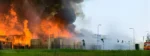
Just before 3 a.m. on Monday, April 6, 2026, the Stanislaus Consolidated Fire Protection District dispatched crews to the 600 block of Mariposa Road in Modesto. Arriving firefighters found a commercial building fully involved, with heavy flames throughout the structure. Six engines, two quints, two battalion chiefs, and the Stanislaus County Fire Investigation Unit responded. The fire’s intensity and the immediate threat to a nearby pallet yard forced crews into a defensive strategy, using multiple hose lines to contain the blaze and protect surrounding properties. No injuries were reported. The cause remains under investigation, according to the Modesto Bee report published April 6, 2026.
After several hours of suppression and overhaul operations, crews cleared the scene. But while the flames were out, the damage was far from contained. Smoke and soot had already traveled through the structure and into the surrounding zone, penetrating walls, HVAC pathways, ceiling voids, and structural components well beyond the fire origin point. For any commercial property affected directly or by proximity to this fire, smoke soot cleaning Modesto professionals can deliver is not an optional follow-up step. It is a health, structural, and insurance requirement.
For commercial property owners, property managers, and insurance adjusters handling losses across Modesto and the Central Valley, understanding what smoke and soot damage actually does, how far it travels, and why professional remediation is the only appropriate response is critical to protecting the property, the claim, and anyone who will eventually re-occupy the building.
How Smoke and Soot Travel After a Commercial Fire
The assumption that smoke damage is limited to the area closest to the fire origin is one of the most costly mistakes a property owner can make. In a fully involved commercial structure fire like the one at Mariposa Road, smoke and soot move aggressively through every available pathway in the building.
HVAC systems are the primary migration route in commercial buildings. When a fire burns through a structure, heat and pressure differentials draw smoke through return air pathways, ductwork, and wall penetrations across the entire building footprint. Soot deposits are a consistent finding in areas with no visible fire damage, often discovered in ceiling voids, wall cavities, and ductwork far from the fire origin. The Modesto Regional Fire Authority investigates more than 300 fires each year across Modesto and Stanislaus County. In virtually every significant commercial fire, smoke migration extends beyond the immediately affected zone.
The defensive firefighting strategy used at Mariposa Road, where crews focused on containment and protecting a nearby pallet yard rather than interior suppression, means smoke and soot were not confined to a single area. Adjacent commercial properties within the immediate zone should assess for soot deposition regardless of whether they sustained direct fire damage. Smoke soot cleaning Modesto property managers need is often required in buildings where no fire occurred at all, purely from smoke exposure during a nearby event.
The U.S. Environmental Protection Agency’s guidance on indoor air quality in commercial buildings confirms that smoke particles infiltrate structures through ventilation systems, building envelope gaps, and open access points, creating persistent indoor air quality hazards that require active remediation to resolve. The same physical principles that apply to wildfire smoke apply equally to structural fire smoke from a nearby commercial building.
What Smoke and Soot Actually Do to a Commercial Building
Soot is acidic. That single fact separates smoke and soot damage from ordinary contamination, and it explains why the timeline for smoke soot cleaning Modesto businesses require is as important as the cleaning itself.
When soot deposits on walls, ceilings, structural components, and surfaces, it begins an ongoing chemical reaction. Acidic soot residue reacts with moisture in the air and with the materials it contacts, etching surfaces, corroding metals, degrading finishes, and permanently staining materials that could otherwise be cleaned and retained. In a commercial building, this means control panels, HVAC components, exposed metal framing, electrical fixtures, equipment, and plumbing fittings are all at active risk from every hour of soot contact that goes untreated.
Different fires produce different soot chemistry. A fully involved commercial structure containing synthetic materials, stored goods, industrial equipment, and mixed building components produces a complex mixture of wet smoke residues, dry soot particulates, and combustion byproducts, each requiring a different cleaning approach. Using the wrong method, including standard household cleaners, dry sweeping, or non-HEPA vacuum equipment, redistributes soot particles into the air and embeds them more deeply into porous surfaces, compounding the damage rather than addressing it.
Operating HVAC systems in a smoke-exposed building before ductwork has been assessed and cleaned distributes soot throughout the entire building every time the air handler runs, recontaminating cleaned surfaces and dramatically increasing both the scope and cost of remediation.
What Smoke Soot Cleaning Modesto Professionals Provide
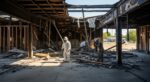
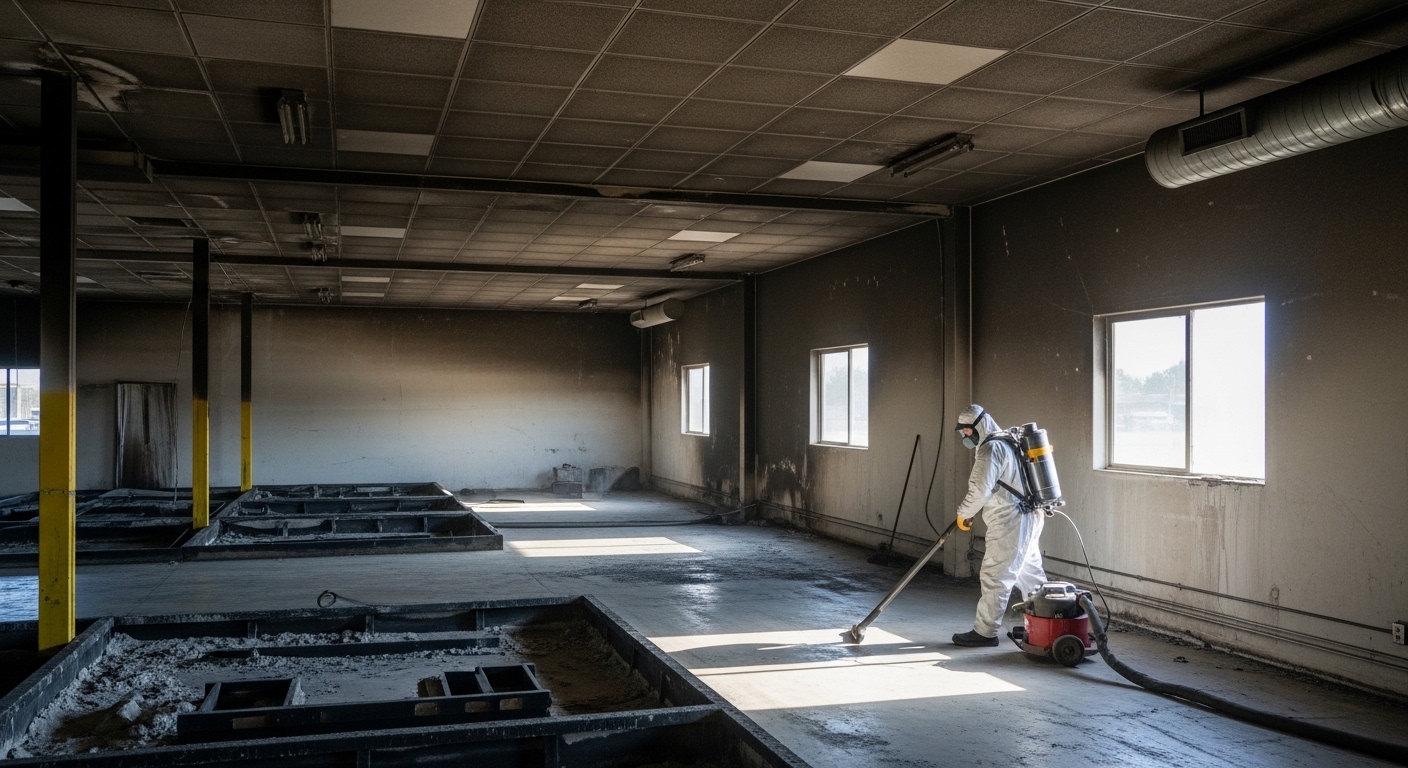
Smoke and soot cleaning is a structured mitigation process. It begins with a full site assessment to map the extent of soot deposition throughout the building, identify the types of residue present, and confirm affected pathways including wall cavities, ceiling voids, and HVAC systems.
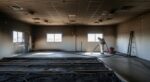
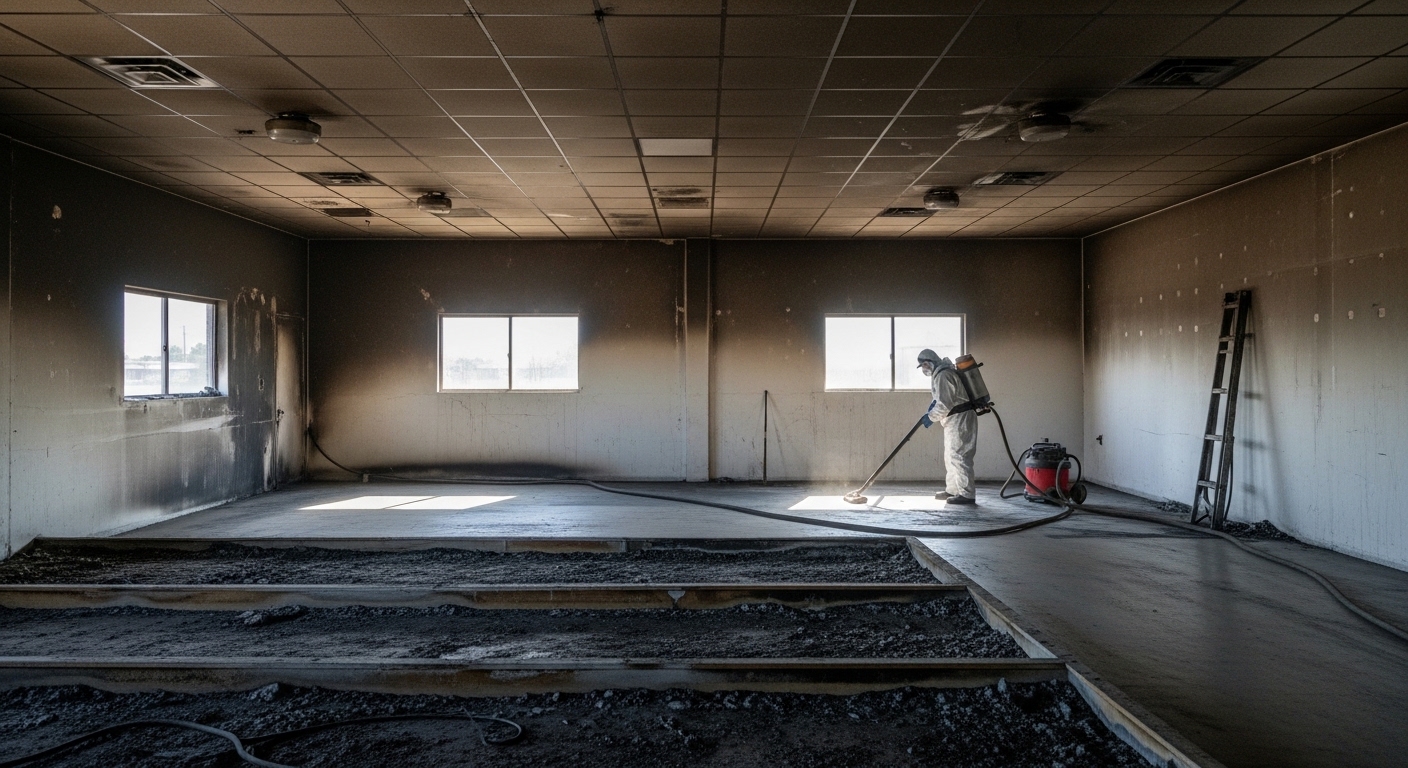
HEPA vacuuming is the first active cleaning step. High-efficiency particulate air vacuum systems capture soot particles at the microscopic level without redistributing them into the air. This is the critical failure point of standard vacuum equipment. Dry chemical sponges are applied on painted and finished surfaces to lift soot without smearing it deeper into the substrate. Structural component cleaning follows, addressing exposed framing, ceiling decking, wall framing, and any structural element with soot deposition.
Ceiling soot cleaning in commercial buildings requires particular attention. In a fully involved fire or a fire fought with large-volume suppression, soot accumulates heavily on horizontal ceiling surfaces and inside ceiling cavities. This soot off-gases and deposits onto surfaces below it continuously if not addressed as part of the full cleaning scope.
Wall cavity inspection and cleaning addresses soot that penetrates electrical conduit runs, wall penetrations, and gaps in the building envelope. A professional smoke soot cleaning Modesto scope includes investigation of these pathways and treatment wherever contamination is confirmed.
HVAC assessment and cleaning is a mandatory component of any commercial smoke mitigation project. Soot-contaminated ductwork left in place redistributes particulates throughout the building every time the air handling system operates, creating ongoing air quality problems and recontaminating cleaned surfaces. HVAC scope includes ductwork assessment, filter replacement, and where necessary, full duct cleaning before the system returns to operation.
Soot documentation and reporting completes the process. Every affected area is photographed, cleaning methods and agents are recorded, and results are documented in a format that supports the insurance claim and provides the adjuster with the evidence needed to process the scope of work.
Licensing, Standards, and Re-Occupancy
A commercial building that has been exposed to smoke from a fully involved structural fire cannot be safely re-occupied until smoke soot cleaning Modesto requirements have been met and indoor air quality has been assessed. This is not a comfort consideration. It is a health and legal liability consideration for every property owner, manager, or employer responsible for the building and the people in it.
The California Contractors State License Board requires that contractors performing mitigation work on fire-damaged commercial structures hold a valid California contractor license. RedTag Property Mitigation operates as a division of Highly Favored Contractors Inc., holding CSLB General Contractor license #1130391, the appropriate classification for commercial smoke soot cleaning Modesto property owners and managers need after a fire loss.
Professional smoke and soot restoration is governed by IICRC standards for fire and smoke damage restoration, which establish procedures, documentation requirements, and contractor qualifications for this category of work. RedTag is IICRC certified and applies these standards to every commercial fire loss, producing documentation packages designed to align with insurance carrier requirements and support efficient adjuster review.
For multi-tenant commercial buildings, retail centers, office complexes, and warehouses, the re-occupancy timeline depends entirely on how quickly professional smoke soot cleaning Modesto mitigation is initiated and completed. Every day of delay extends the period of soot-induced surface damage, keeps tenants and employees displaced, and risks secondary mold development from suppression water in structural materials.
What Property Owners and Managers in Modesto Should Do Now
If your property or any property in your portfolio has been exposed to smoke from a nearby fire across Modesto or the Central Valley service area, the assessment process should begin as soon as the site is accessible.
Do not attempt surface cleaning before a professional assessment. Premature cleaning using incorrect methods makes smoke damage worse and reduces the salvageability of materials that could otherwise be retained. Do not operate HVAC systems in a smoke-exposed building before ductwork has been assessed. Contact a licensed, IICRC-certified contractor as soon as the building is accessible. The speed of response directly affects how much surface damage the soot causes before it is removed and how much material can be saved versus replaced.
RedTag Property Mitigation provides smoke soot cleaning Modesto commercial properties can access 24 hours a day, 7 days a week. Visit the contact page to request emergency dispatch.
Frequently Asked Questions
How far does smoke and soot travel from a commercial fire?
Smoke and soot from a commercial fire can travel throughout an entire structure and into adjacent buildings, well beyond any area of visible fire damage. Smoke moves through HVAC systems, wall penetrations, ceiling voids, and gaps in the building envelope, driven by heat and pressure differentials. In a fully involved commercial fire where a defensive firefighting strategy was used, smoke exposure can extend to neighboring structures in the immediate vicinity. A professional assessment is the only way to accurately determine the full extent of soot deposition, because significant contamination often exists in areas with no visible damage. Smoke soot cleaning Modesto professionals begin every project with a complete site assessment to map all affected zones before any cleaning begins.
Can a commercial building be re-occupied after smoke damage without professional cleaning?
Re-occupying a smoke-damaged commercial building without professional cleaning creates measurable health risks and potential legal liability. Combustion byproducts including fine particulate matter and volatile organic compounds from soot are documented indoor air quality hazards that persist in building materials and HVAC systems without active remediation. The EPA confirms that smoke particles infiltrating commercial buildings through ventilation systems and building envelope gaps create persistent indoor air quality problems requiring professional intervention. For employers and property managers, returning workers or tenants to a building with untreated smoke contamination creates occupational health exposure that can result in regulatory and legal consequences.
Why is HEPA vacuuming required for smoke soot cleaning Modesto properties?
Standard vacuum equipment does not capture soot at the fine particulate level and redistributes particles into the air during operation, making contamination worse. HEPA vacuum systems trap particles as small as 0.3 microns at a minimum efficiency of 99.97%, which is the level required to capture the fine soot particulates produced by building fires. Using non-HEPA equipment to attempt smoke soot cleaning Modesto commercial properties scatters airborne particulates, embeds soot more deeply into porous surfaces, and increases both the scope of cleaning required and the total remediation cost significantly.
Does smoke and soot damage affect a commercial HVAC system?
Yes, and it is one of the most critical components to address in any commercial smoke mitigation project. Soot particles enter HVAC ductwork through return air pathways during a fire event. Operating the air handling system after smoke exposure without prior duct assessment and cleaning distributes soot throughout the building, recontaminates areas that have been cleaned, and deposits fine particulates on surfaces and equipment across the entire building footprint. For any commercial property, HVAC assessment and cleaning is a mandatory step in the smoke soot cleaning Modesto scope before the system can be safely returned to operation.
What is the difference between smoke cleaning and full smoke remediation?
Smoke cleaning refers to the physical removal of soot and smoke residue from surfaces using HEPA vacuuming, dry chemical sponges, and appropriate wet cleaning agents. Full smoke remediation is the broader process encompassing cleaning, HVAC treatment, odor control, air quality verification, and complete documentation. For insurance purposes, full smoke remediation is what carriers require, not surface cleaning alone. A documented scope of work that includes all affected areas, cleaning methods used, and post-cleaning condition verification is the standard required for insurance claim processing and for confirming the building is safe for re-occupancy. Smoke soot cleaning Modesto professionals at RedTag produce this documentation as a standard component of every commercial fire loss project.
Conclusion
Smoke and soot damage after a commercial fire is time-sensitive, technically specific, and directly connected to the insurance outcome and re-occupancy timeline. The April 6, 2026 Mariposa Road fire is a current local example of how smoke contamination spreads across a wide zone, including into buildings that never caught fire. Smoke soot cleaning Modesto commercial property owners and managers depend on starts with a professional assessment, proceeds through HEPA-based cleaning of all affected surfaces and systems, and ends with documented verification that the building is safe to return to use. Every hour of delay adds to surface damage and extends the recovery timeline.
More Services
For more information about commercial fire, smoke, and related mitigation services at RedTag Property Mitigation, check them out below:
- Commercial Water Mitigation & Structural Drying
- Commercial Fire, Smoke & Soot Mitigation
- Mold Mitigation Support
- Storm & Emergency Mitigation
- Contents & Asset Protection
- Biohazard & Trauma Scene Cleaning
External Sources Used (for reference only):
- https://www.aol.com/news/firefighters-battle-early-morning-blaze-224026268.html — Modesto Bee / AOL News — April 6, 2026
- https://www.epa.gov/emergencies-iaq/wildfires-and-indoor-air-quality-schools-and-commercial-buildings — US EPA Indoor Air Quality — current
- https://www.modestogov.com/1053/Fire-Investigations — City of Modesto Fire Investigations — current
- https://www.cslb.ca.gov/Media_Room/Disaster_Help_Center/ — California CSLB Disaster Help Center — current
- https://iicrc.org/current-standards-field-guides-test/ — IICRC Standards — current