On April 1, 2026, the California Department of Water Resources conducted its annual Sierra Nevada snow survey at Phillips Station and recorded no measurable snow. According to the DWR’s April 2026 report, the statewide snowpack is currently at just 18% of average for this date, the second lowest April reading on record. A record hot March and an early warm atmospheric river in late February triggered snowmelt several weeks ahead of schedule across the Sierra Nevada. DWR Director Karla Nemeth noted that what should have been a gradual seasonal melt happened suddenly, weeks before it was expected.
For commercial property owners and managers in Modesto, this is useful context, not cause for alarm. The Tuolumne River, which runs directly through Modesto and is one of the two waterways the City of Modesto identifies as an active flood factor, is fed by Sierra Nevada snowmelt and reservoir releases. When water managers are balancing flood control and water supply decisions earlier than normal in the season, it is a reasonable time for any commercial property owner in the area to review what their preparedness looks like if water enters their building.
Spring is historically the period when water-related property losses in the Central Valley are most likely, whether from storm drainage backup, plumbing failures under increased load, or ground saturation affecting slab-on-grade commercial structures. Knowing what emergency water extraction Modesto professionals provide, and understanding what to do in the first hours after water enters a commercial building, is practical knowledge that applies regardless of the season.
What the Tuolumne River and Dry Creek Mean for Modesto Properties
The City of Modesto’s storm information page confirms that both the Tuolumne River and Dry Creek could impact flooding across the city. The Stanislaus County Office of Emergency Services confirms that flash floods can develop in minutes without visible signs of rain, and that riverine floods along waterways like the Tuolumne can develop gradually over days. Both types of events create conditions that affect commercial buildings, though in different ways and on different timelines.
For commercial properties in low-lying areas near the Tuolumne or along Dry Creek, the risk profile is higher. But water intrusion into commercial buildings does not require a major flood event. Overwhelmed storm drains, slab failures, broken supply lines, and roof membrane failures during rain events all produce water damage scenarios that require emergency water extraction Modesto contractors are equipped to address. The FEMA-updated Stanislaus County flood maps, last revised in 2020 in collaboration with the City of Modesto, confirm that approximately 12% of Modesto buildings carry significant flood risk. Standard commercial property insurance does not cover flooding, and a separate flood insurance policy is required for buildings in designated flood zones.
Reviewing flood zone status, insurance coverage, and the response plan for a water intrusion event before one occurs is the most practical thing a commercial property owner or manager can do right now. Knowing who to call and what happens in the first hour is what separates a contained loss from a prolonged one.
What Emergency Water Extraction Modesto Involves
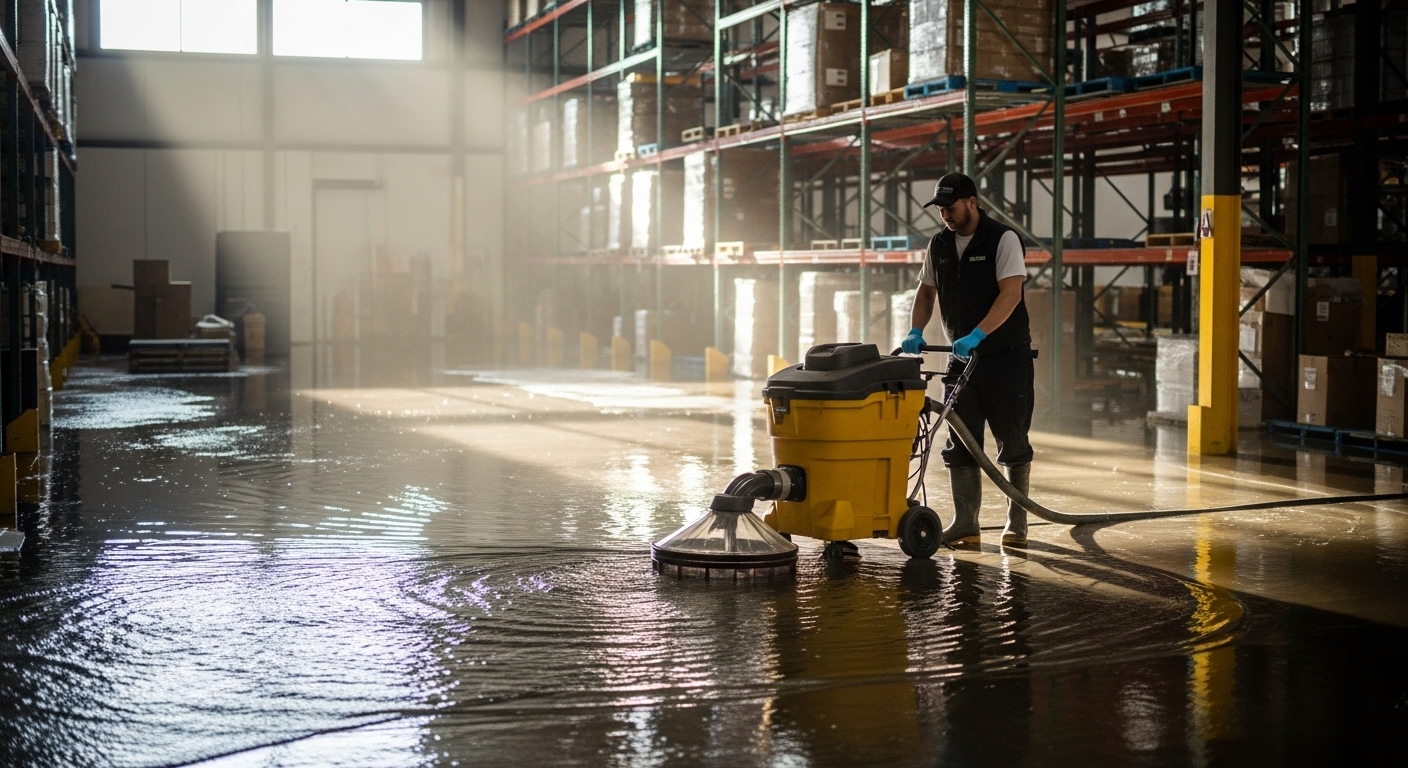
Emergency water extraction is the first active step after water enters a commercial building. It is the commercial-grade removal of standing water before structural drying, moisture mapping, and any further remediation can begin. The speed of this step directly determines how much of the building can be dried and retained versus how much requires removal and replacement.
The category of water involved shapes the entire response. Category 1 water, from a clean supply line or rain intrusion through a roof membrane, carries relatively low contamination risk. Category 2 water, from appliance overflow or dishwasher discharge, carries biological contamination requiring appropriate protective measures and treated procedures throughout. Category 3 water, which includes sewage backup, floodwater from outdoor sources, or any water that has been standing long enough to degrade in classification, is a serious contamination event requiring full protective protocols, regulated disposal, and thorough antimicrobial treatment of all affected surfaces after extraction is complete.
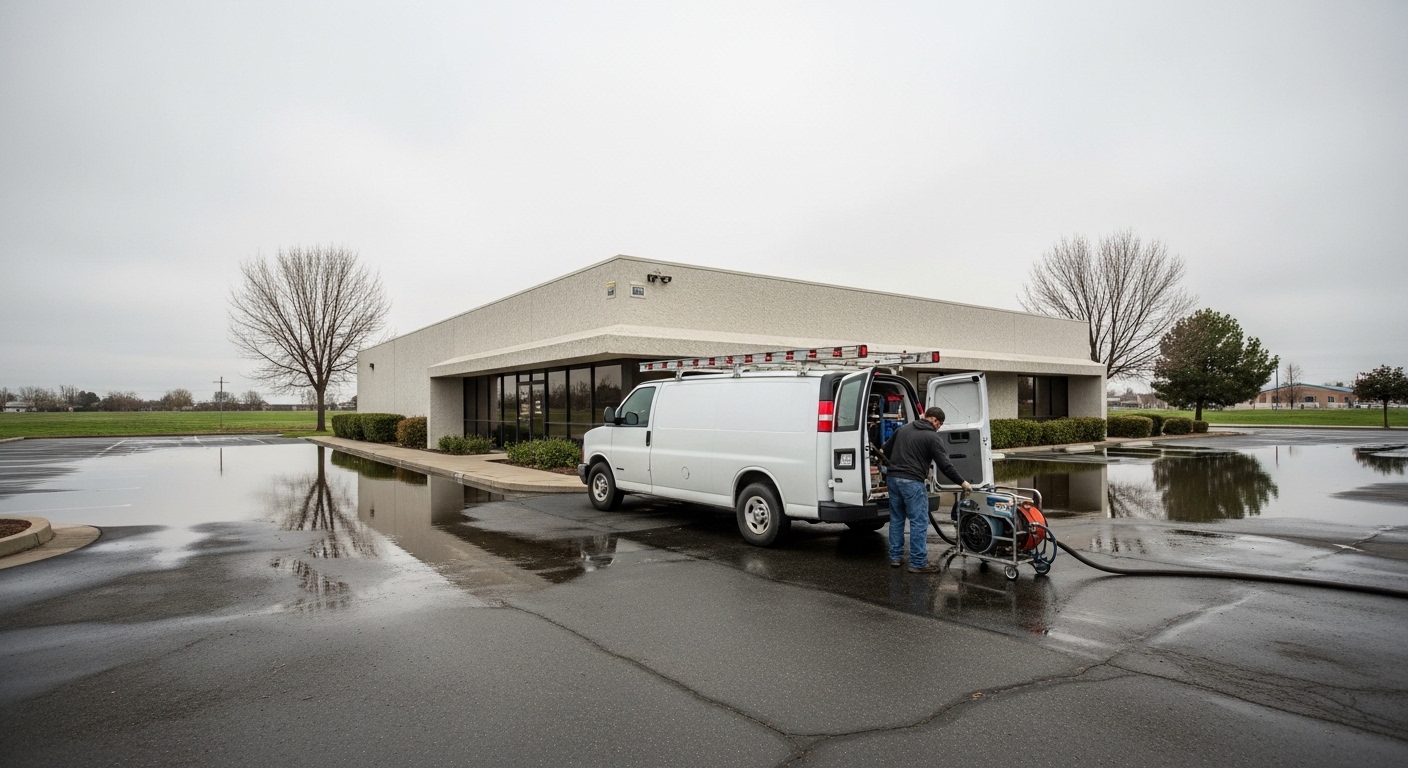
Floodwater entering a Modesto commercial building from street drainage, storm backup, or river-adjacent sources is almost always Category 3. Emergency water extraction Modesto commercial properties require after a Category 3 event is not simply pumping out standing water. It involves commercial extraction equipment operation with full safety protocols, plumbing shutoff and source isolation where applicable, sewage backup extraction where present, and high-volume pump-out for significant standing water situations.
Source isolation is a step that often gets overlooked in the urgency of dealing with visible water. If water is still entering the structure while extraction is underway, the work is ineffective. Identifying and stopping the source before or alongside active extraction is a prerequisite to any lasting result. A professional emergency water extraction Modesto team addresses source isolation as part of the initial site assessment, not as an afterthought.
Why the First 24 Hours Determine the Outcome
The IICRC S500 Standard for Professional Water Damage Restoration establishes that mold growth can begin on wet building materials within 24 to 48 hours under standard indoor conditions. In Modesto’s Central Valley climate, where spring and summer temperatures are warm and ambient humidity supports biological activity, that window can be shorter. This is the single most important fact for any commercial property owner to understand about emergency water extraction Modesto professionals emphasise.
A water event that receives a professional extraction response within the first few hours has a significantly different outcome than one where the property owner waits to assess the situation, consults with insurance, or attempts manual cleanup with consumer equipment first. Every additional hour of water contact with structural materials, wall assemblies, flooring substrate, and insulation increases the volume of material that will need to be removed rather than dried. It directly extends the mitigation timeline, the reconstruction scope, and the business interruption period.
For a commercial property with active tenants, an occupied retail space, or an operating warehouse, the cost of a delayed response compounds quickly. The mitigation cost is not just the extraction and drying. It is every additional day of tenant displacement, lost revenue, and prolonged reconstruction that a faster response would have avoided.
What Follows Emergency Water Extraction
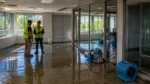
Emergency water extraction Modesto teams complete is the beginning of a structured mitigation sequence, not the end point. Once standing water has been removed, the following steps apply immediately.
Moisture mapping and thermal imaging identifies all areas of water migration beyond the visible affected zone. Water travels through wall cavities, under flooring assemblies, into subfloor systems, and through building penetrations. Without thermal imaging, wet materials remain concealed and become a mold and structural degradation source even after the visible water has been addressed. Commercial water mitigation and structural drying uses moisture meter readings and thermal imaging wall scans to document exactly where water has migrated and to confirm drying progress at every location throughout the drying period.
Structural drying follows using commercial air movers and industrial dehumidifiers deployed based on the moisture mapping findings. Daily moisture log recording tracks progress and provides the documentation required for the insurance claim. Wall cavity drying and subfloor drying systems address concealed moisture that surface drying equipment cannot reach.
All documentation produced throughout the emergency water extraction Modesto process, including photo logs, moisture readings, equipment placement records, and drying progress reports, forms the insurance claim package. RedTag is IICRC certified to S500 Water Damage standards and produces Xactimate scope documentation aligned with the format used by commercial insurance carriers and their adjusters.
A Simple Preparedness Checklist for Modesto Commercial Property Owners
With spring conditions across the Tuolumne watershed prompting early water management activity, now is a practical time for any commercial property owner or manager in Modesto and the Central Valley service area to work through the following.
Check your flood zone status. Use the FEMA flood map tool referenced on the Stanislaus County floodplain management page to confirm whether your property is in a designated flood zone and whether separate flood insurance is in place.
Know your water shutoff location. In any water intrusion event, the ability to isolate the source immediately reduces the volume of water entering the building. Every property manager and building supervisor should know where the main shutoff is and how to operate it.
Have a mitigation contractor identified in advance. The worst time to search for an emergency water extraction Modesto contractor is at 2 a.m. when standing water is present in your building. Having a licensed, IICRC-certified contractor saved as an emergency contact removes a decision from a stressful situation.
Review your insurance documentation. Confirm whether your commercial policy includes water damage coverage, understand what categories of water events are covered, and verify whether a separate flood policy is needed for your location.
RedTag Property Mitigation provides emergency water extraction Modesto commercial properties can access 24 hours a day, 7 days a week. Visit the contact page for immediate dispatch.
Frequently Asked Questions
What is emergency water extraction and when does a commercial property need it?
Emergency water extraction is the commercial-grade removal of standing water from a building following a flood, plumbing failure, storm intrusion, sewage backup, or any other water intrusion event. A commercial property needs emergency water extraction Modesto professionals can provide any time water has entered the structure and is in contact with flooring, wall assemblies, structural framing, or building contents. The response should begin within the first few hours of the event. Every hour of delay increases the volume of structural material requiring replacement rather than drying, and raises the probability of secondary mold development within the 24 to 48 hour window established by IICRC S500 standards.
Does standard commercial property insurance cover water damage from flooding in Modesto?
Standard commercial property insurance does not cover flooding. Flood damage requires a separate flood insurance policy, available through the National Flood Insurance Program or private flood insurance carriers. FEMA’s updated Stanislaus County flood maps confirm that multiple zones in Modesto carry significant flood risk, particularly in areas adjacent to the Tuolumne River and Dry Creek. Commercial property owners in any flood-risk zone should verify their flood insurance status independently of their standard commercial policy. Even with the correct coverage in place, the insurance outcome after a water event depends heavily on how quickly professional emergency water extraction Modesto mitigation begins and how thoroughly the damage is documented.
What is Category 3 water and why does it change the response?
Category 3 water is grossly contaminated water carrying serious health risks. It includes sewage backup, floodwater from outdoor drainage systems, and any water that has been standing long enough to develop bacterial growth. In Modesto, water entering a commercial building from street flooding, storm drain backup, or sources adjacent to the Tuolumne River or Dry Creek is almost always Category 3. Emergency water extraction Modesto teams handling Category 3 events use full protective equipment, commercial extraction systems with containment protocols, and complete antimicrobial treatment of all affected surfaces after extraction. The water category determines the scope, safety protocols, cost, and documentation requirements of the entire mitigation project.
How quickly can mold develop after water enters a commercial building?
Under standard indoor temperature and humidity conditions, mold can begin establishing itself on wet building materials within 24 to 48 hours. In Modesto’s Central Valley climate during spring and summer, warm ambient temperatures can shorten that window. This is why emergency water extraction Modesto professionals treat the first 24 hours as the most critical period in the entire mitigation process. Extraction that begins within the first few hours of a water event produces a significantly better outcome than one that begins after a day of assessment and deliberation. The goal is to reduce the water contact time with structural materials to the minimum possible from the moment the event is identified.
What documentation is needed for a commercial water damage insurance claim in California?
A commercial water damage insurance claim requires photo documentation of all affected areas before extraction begins, moisture reading logs at each mapped location, equipment placement records for all drying equipment deployed, daily drying progress reports throughout the structural drying phase, and a final scope of work in Xactimate format used by commercial insurance carriers. Emergency water extraction Modesto IICRC-certified contractors produce this documentation as a standard component of every commercial water mitigation project. Incomplete or non-standard documentation is one of the primary causes of insurance claim delays after a commercial water event. Having a licensed contractor engaged from the first hour of the event ensures the documentation package is complete from the start.
Conclusion
Spring 2026 is a practical time for commercial property owners and managers in Modesto to review their water preparedness. The California DWR’s April 1 snow survey findings confirm that the Tuolumne River watershed experienced earlier than normal snowmelt this season, which is relevant context for any property in the area rather than a cause for concern. Knowing what emergency water extraction Modesto professionals do, understanding the 24-hour mold window, and having a response plan in place before a water event occurs is the kind of preparation that protects both the building and the insurance outcome. Water damage is one of the most common and most manageable commercial property losses when the response is fast, professional, and fully documented.
More Services
For more information about commercial water mitigation and related services at RedTag Property Mitigation, check them out below:
- Commercial Water Mitigation & Structural Drying
- Commercial Fire, Smoke & Soot Mitigation
- Mold Mitigation Support
- Storm & Emergency Mitigation
- Contents & Asset Protection
- Biohazard & Trauma Scene Cleaning
External Sources Used (for reference only):
- https://water.ca.gov/News/News-Releases/2026/Apr-2026/Record-Hot-Dry-March-Wipes-Out-California-Snowpack-Leaving-No-Measurable-Snow-for-April-Survey — California DWR — April 1, 2026
- https://www.modestogov.com/1106/Storm-Related-Information — City of Modesto Storm Information — current
- https://www.stancounty.com/planning/bp/floodplain-management.shtm — Stanislaus County FEMA Flood Maps — 2020, current
- https://oes.stancounty.gov/stanemergency/emergencies-disasters/floods — Stanislaus County OES Floods — current
- https://iicrc.org/current-standards-field-guides-test/ — IICRC Standards — current